
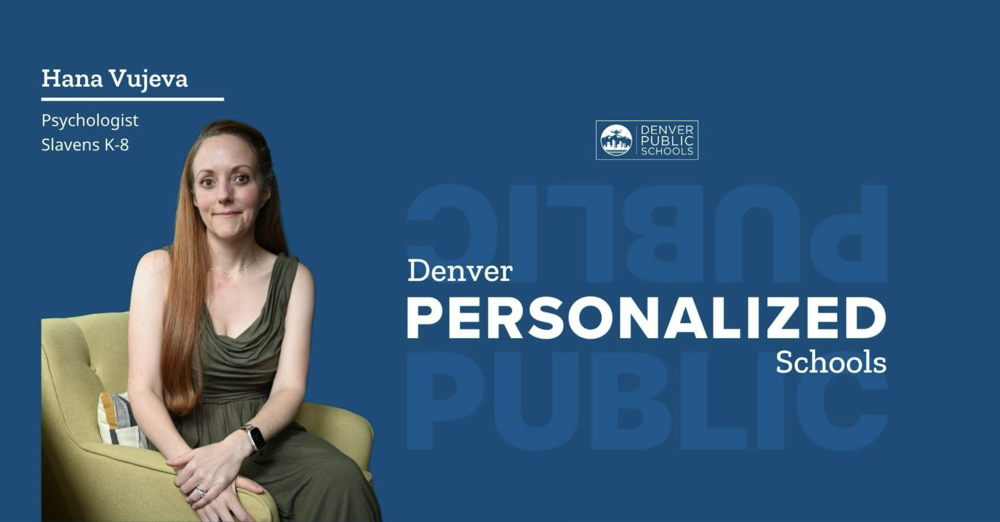
Nestled quietly in a top corner of Slavens K-8 School is a special place. A serene office with natural light from a wall of windows, soft blue gray walls, an avocado green accent chair, eclectic decor and black and white farm animal art. Hana Vujeva, Slavens’ psychologist, is just as special as the space she has created. Here, Hana provides a place for those in the Slavens community to be vulnerable, to learn, to hurt, to laugh, to process, but most importantly, to work together on what is needed to help students to thrive.
An aspiring veterinary student, Hana was pursuing an undergraduate degree in biology at New York University (NYU) in 2001. Ready to conquer the world and continue her career path working and caring for animals, a significant life event took place that forever changed her path and purpose — Sept. 11, 2001 — when New York and the United States experienced an act of terrorism. Uncertainty in day-to-day life affected everyone. What happens now? What does life look like now? How do we continue to support each other, repair, heal and move forward?
At the time of the attacks, Hana was participating in a work study program in two different New York City elementary schools. One school was geographically further from the attacks, in Brooklyn, while the other was much closer in both distance and community to the World Trade Center. She observed a surprising difference in the emotional responses of students between these schools, and subsequently became interested in how life experiences may shape a child’s ability to cope with trauma. From here, Vujeva began working with Dr. Elizabeth Hume at NYU’s Child Study Center to understand how the attacks had impacted public school children. The project found that students with higher cumulative life trauma had substantially higher PTSD symptoms following the attacks, regardless of their Sept. 11 “exposure dose.” Hana also saw first hand the incredibly important role schools had in supporting the wellbeing of children, which prompted her to shift the focus of her studies from medicine to psychology and education. She continued on to pursue two graduate degrees in clinical and school psychology at the University of Denver and University of Colorado at Denver, bringing her to Colorado.
Research and writing are natural passions for Hana. Between undergrad and graduate school, Hana published several papers sharing her knowledge, experience and research in numerous scientific and industry journals. Her work focused on the emergence of mental health issues in childhood, as well as diagnostic and treatment modalities for childhood mental illness. Her continued study of the connection between adolescent depressive symptoms and the development of important relationship skills was merely one of the areas where she gained knowledge to apply in an educational setting.
Hana came as school psychologist to Slavens in 2015. At that time, Hana served more than 700 students working three days per week. The families and staff immediately felt her impact, and subsequently advocated to make Hana full-time. Since then, Slavens has further expanded their mental health services to include multiple positions supporting the wellness of Slavens students.
Hana’s contributions to Slavens are not limited to supporting students’ mental health and wellness. Her love for analytics, research and data give her the opportunity to also support the school by crunching and interpreting information such as CMAS scores, attendance, BESS screenings and more. Her ability to identify themes and patterns in data is leveraged in discussions with staff and families alike, providing the opportunity to create strategic game plans and intentional work supporting every aspect of a child’s educational journey.
“Her work does not go unnoticed,” Assistant Principal Corey Wagner spoke toward Hana’s contributions to the Slavens family. “Through her work with our Student Intervention Team and as the 504 coordinator, she brings together teachers, specialists and families to understand the whole child. She helps us look beyond a single score or behavior to develop support based on each student’s unique strengths, needs and lived experiences. Her desire to listen and see the whole picture allows her to incorporate the families’ hopes, values and needs.”
Hana describes her contributions to Slavens as personalized.
As she explained, “I really strive to understand each individual student and family to best serve and support them. This can look very different per student. For some people, it's frequent communication and check in, or it could be digging into research or training or treatment modality.”
“[Hana] makes kids and families feel comfortable and her positive attitude ensures everyone that everything will be ok,” stated fourth grade educator Bo Sager. He continued, “Personalized really hits home when it comes to [Hana] working with staff. From formal meetings helping everyone get prepared to being available for quick check-ins, Hana is always there to provide support on a professional and personal level. Her door is always open and she is at least a speedy email response away.”
The abundance of support and endorsements Hana receives from her school staff and families reiterate that Hana is right where she needs to be. She is loved dearly and appreciated by all, and the Slavens community is so lucky to have her! Thank you, Hana, for dedicating your tireless work in supporting the mental health of our students!
Funding for student mental health support is part of the 2026 Mill Levy Override ballot initiative. Learn more about the 2026 Mill Levy Override.