
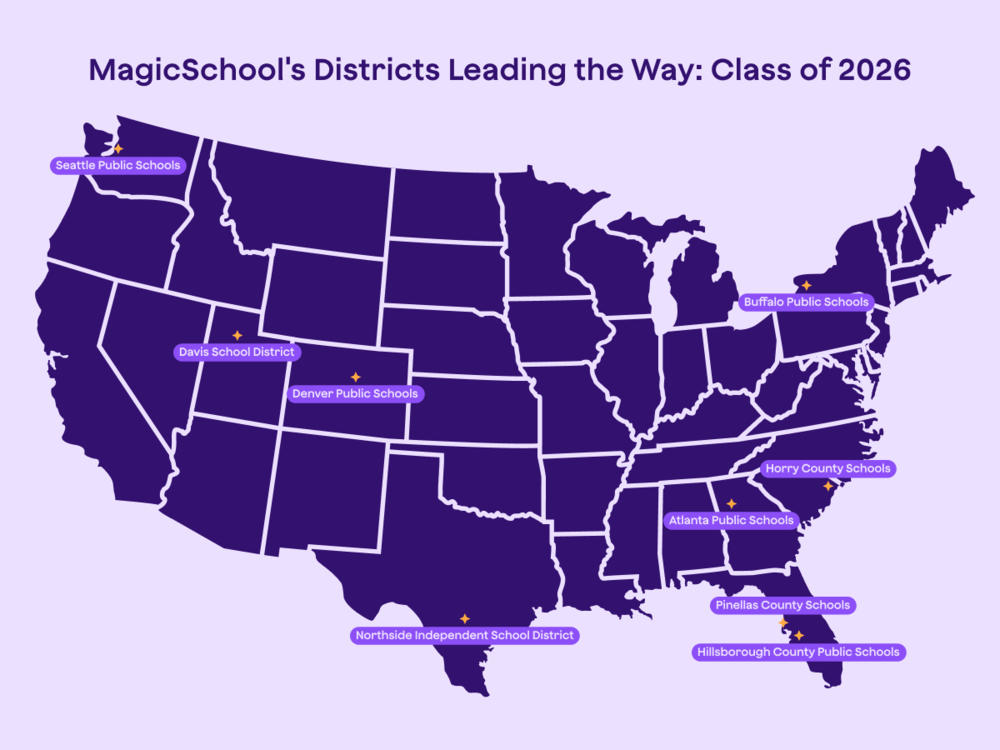
Denver, Colorado – June 10, 2026: MagicSchool, the leading AI platform built for K-12 schools, today released its inaugural "Districts Leading the Way: Class of 2026" report, recognizing 10 U.S. school districts that are approaching AI with intention, keeping teachers at the center and students at the heart of every decision.
Every year, school districts across the country make bold decisions on behalf of their students and teachers. They rethink long-standing systems, explore new approaches, and look for ways to better support learning in a rapidly changing world. The “Districts Leading the Way: Class of 2026” represents communities doing exactly that: exploring AI with care and curiosity, staying grounded in the values that make great teaching possible, and finding new ways to give educators more valuable time back with their students.
"Each of these ten districts is approaching AI implementation the right way. They’re asking the difficult questions, staying close to what their teachers need, bringing families into the conversation, and making sure this technology makes a meaningful difference in student outcomes," said Adeel Khan, founder and CEO of MagicSchool. "They're setting the standard for how new technology should be introduced in schools, and every community in the country can learn from their approach."
The 2026 Class of Districts Leading the Way:
Atlanta Public Schools, Georgia: In Atlanta, district leaders are approaching AI with a strong focus on people. Serving approximately 50,000 students, Atlanta Public Schools has looked at how new tools can help educators provide more individualized support while creating more opportunities for meaningful student engagement.
Across the district, conversations about AI have remained closely connected to relationships: supporting teachers, strengthening connections with students, and helping learners feel seen throughout the educational experience. Atlanta stands out for keeping human connection at the center of its approach to innovation.
Buffalo Public Schools, New York: In Buffalo, district leaders and educators are focused on supporting students across a wide range of academic and community needs. Serving approximately 34,000 students, Buffalo Public Schools has looked at how AI can help teachers spend less time on routine tasks and more time focused on students.
Across the district, educators are finding opportunities to streamline administrative work while creating more space for instruction, feedback, and meaningful student support. Buffalo's experience highlights an important belief: when teachers have the time and capacity they need, students benefit too.
Davis School District, Utah: North of Salt Lake City, Davis School District is planning for the needs of a growing student population. Serving approximately 70,000 students, district leaders have focused on helping educators maintain personalized learning experiences while supporting students across a rapidly expanding district.
Teachers across Davis are using AI to help streamline routine tasks and create more opportunities for individualized support. Even as enrollment increases, the district is committed to preserving the relationships, responsiveness, and personal attention that help students feel seen and supported.
Denver Public Schools, Colorado: For Denver Public Schools, conversations around AI have been closely connected to broader efforts to support educators and build sustainable practices across the district. Serving approximately 90,000 students, DPS has focused on how new tools can fit naturally into teachers’ existing routines and responsibilities.
Rather than limiting AI to small-scale pilots, district leaders have considered how it can support educators across schools and classrooms. The result is an approach that emphasizes consistency, accessibility, and practical support for teachers throughout the district.
Hillsborough County Public Schools, Florida: In the Tampa Bay region, Hillsborough County Public Schools have approached AI with both urgency and care. Serving more than 224,000 students across one of Florida’s largest districts, leaders moved early to identify ways AI could support educators in practical, classroom-ready ways and help teachers navigate growing demands on their time.
Across the district, educators are finding ways to save time on planning and differentiation while creating more space for student support and engagement. Hillsborough stands out for its willingness to move thoughtfully at scale, recognizing that supporting teachers through change matters just as much as the technology itself.
Horry County Schools, South Carolina: Stretching from South Carolina's coastline to its inland rural communities, Horry County Schools serves students across a wide range of communities and learning environments. District educators have focused on how AI can provide flexible support for teachers and students across the county.
From beach communities to suburban neighborhoods and rural schools, educators face different needs and opportunities. Horry County's work is grounded in a commitment to meeting educators where they are and providing tools that can support teaching and learning across an incredibly diverse district.
Northside Independent School District, Texas: In San Antonio, Northside ISD is demonstrating what thoughtful AI adoption can look like at scale. Serving more than 107,000 students, the district has taken a measured, system-wide approach to supporting educators as AI tools become part of everyday teaching and learning.
Rather than treating AI as a separate initiative, Northside has focused on helping educators incorporate new tools into familiar routines and responsibilities. The result is an approach that feels practical, sustainable, and designed to support long-term success.
Pinellas County Schools, Florida: Along Florida’s Gulf Coast, Pinellas County Schools has focused its AI efforts on helping teachers make the most of their time. Serving a diverse student population across urban and suburban communities, the district has looked at how AI can help educators differentiate instruction and meet students where they are.
Across Pinellas, teachers are finding opportunities to spend less time on repetitive tasks and more time focused on planning, feedback, and student engagement throughout the school day.
Seattle Public Schools, Washington: Equity has long been a priority for Seattle Public Schools. Serving roughly 57,000 students, the district has examined how AI can help expand access to learning support across its school communities.
Educators are using AI to support feedback, accessibility, and differentiated instruction while building on the strong teaching already happening in classrooms. Throughout the district, the focus remains on helping more students access the support they need to succeed, regardless of their school or neighborhood.
Williamson County Schools, Tennessee: Just south of Nashville, Williamson County Schools has approached AI as one more way to support great teaching. Serving approximately 45,000 students in one of Tennessee's fastest-growing regions, the district has considered how emerging tools can help educators deepen personalization and enhance classroom experiences.
Educators across the district are finding new ways to support student learning while building on the strong practices already in place. Williamson County's interest in AI grows from a culture of curiosity, continuous learning, and a commitment to helping teachers grow alongside the needs of their students.
About MagicSchool:
MagicSchool is the AI Operating System for Schools, used by millions of educators worldwide. Built by educators, it brings together teacher tools, student-safe AI experiences, and district-level governance in one connected platform.
Teachers use MagicSchool to get hours back each week, reduce burnout, and deliver high-quality instruction without cutting corners. Tools are built for classroom work, from planning and assessment to feedback and differentiation, helping educators meet the needs of every student.
Students learn within clear, teacher-led boundaries through guided AI experiences that build critical thinking, AI literacy, and future-ready skills.
District leaders gain the visibility, control, and safeguards they need to adopt AI responsibly. With strong privacy protections and built-in oversight, MagicSchool makes it possible to scale AI in a way that’s safe, aligned, and grounded in classroom impact.